


Why the Focus Points Journal is the Best Journaling System for ADHD
In a world filled with endless to-do lists, mental clutter, and constant distractions, staying consistent can feel nearly impossible — especially for those with ADHD. Traditional productivity tools often focus on discipline and willpower, but for many people, especially neurodivergent minds, that approach falls short. What’s needed is not another blank notebook or rigid planner, but a system that works with the ADHD brain — not against it.
That’s where the Focus Points Journal comes in. Built on the principles of behavioral psychology, motivation science, and habit formation, it’s a guided journaling system designed to make structure achievable and consistency rewarding.
Rather than simply tracking goals or habits, the Focus Points Journal integrates accountability, reflection, and reward into a single, intuitive process. Over time, it helps users strengthen focus, improve follow-through, and feel genuinely proud of their progress.
Let’s break down why this journal stands apart — and why it’s quickly becoming one of the most effective journaling systems for ADHD management and personal growth alike.
1. Designed for How the ADHD Brain Works
One of the biggest challenges with ADHD is maintaining sustained motivation and attention. The ADHD brain tends to chase novelty — which is why something new and exciting can feel amazing for a few days, only to fade into boredom or avoidance once that initial dopamine boost wears off.
The Focus Points Journal was designed around that neurological reality. Its daily and weekly structures provide small doses of reward and accomplishment that keep the brain engaged over time.
Instead of relying on external pressure or guilt, the journal taps into intrinsic motivation — the satisfaction of earning points, meeting small goals, and seeing tangible evidence of progress. This approach leverages dopamine reward pathways, turning consistency itself into something enjoyable and rewarding.
That means users don’t just start journaling — they actually continue journaling. And that’s where the transformation begins.
2. The Power of the Points System
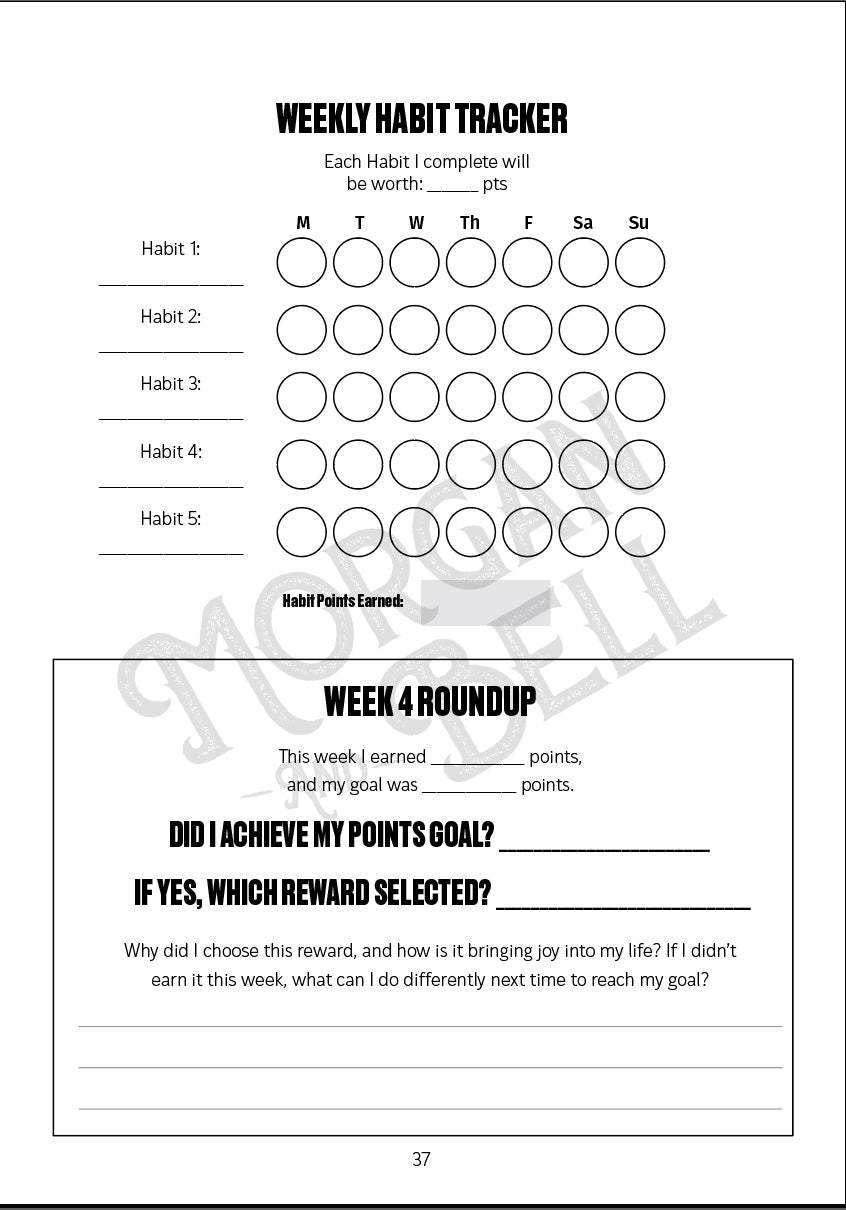
Unlike typical journals that simply offer prompts or blank pages, the Focus Points Journal turns journaling into a structured yet flexible experience. Each day, users complete guided reflections and daily tasks to earn points.
At the beginning of each week, they set a points goal and select a few rewards for hitting it — anything from a small treat to a day off or an activity they enjoy.
This process mirrors operant conditioning, a foundational concept in behavioral psychology, where positive reinforcement encourages desired behaviors. By tying effort to reward, the journal helps train consistency, self-regulation, and delayed gratification — skills often harder to develop for people with ADHD.
The points system also gamifies productivity without turning it into a competition. The focus is on personal progress, not perfection, and the incremental feedback loop helps make even small victories feel meaningful.
3. Structure Without Pressure
A major issue with many planners and productivity systems is rigidity. For someone with ADHD, strict scheduling can quickly lead to burnout or guilt when they inevitably miss a day or fall behind.
The Focus Points Journal provides structure without pressure. Its undated pages allow users to pause when life gets busy and resume without feeling like they’ve failed or “fallen off.” The prompts guide users toward mindfulness, gratitude, and focus — but never demand a certain outcome.
Instead of telling users what to do, it creates a framework for thinking, reflecting, and prioritizing in a way that’s adaptable to each person’s life and energy level.
This flexibility allows the journal to support — not control — the user’s routine, which is exactly what an ADHD-friendly system should do.
4. Scientifically Grounded Prompts
Every page of the Focus Points Journal is backed by psychological principles that promote attention, emotional regulation, and long-term motivation.
The daily prompts encourage self-reflection, gratitude, and forward planning, all of which have been shown to increase emotional well-being and executive function performance.
For instance:
- Gratitude journaling has been linked to improved mood and reduced stress (Emmons & McCullough, 2003).
- Goal visualization and reflection activate the prefrontal cortex, improving focus and decision-making (Locke & Latham, 2002).
- Self-monitoring helps reinforce progress and strengthens intrinsic motivation (Bandura, 1997).
By combining these evidence-based strategies into a simple daily practice, Focus Points makes the benefits of cognitive behavioral therapy and mindfulness-based interventions accessible through journaling.
You don’t have to know the science to benefit from it — but it’s there, woven into every line.
5. Builds Accountability Through Reflection
For many with ADHD, accountability is key — it’s not enough to want to do something; external reminders and feedback loops are what help make it happen.
The Focus Points Journal introduces accountability in a self-contained way. Every week, you review your progress: Did you meet your points goal? What worked? What didn’t?
That simple reflection turns vague awareness into actionable insight. Over time, users begin to recognize patterns — which times of day they’re most productive, which habits truly make a difference, and which distractions keep getting in the way.
This feedback loop encourages self-awareness, one of the most important building blocks of executive functioning.
It’s not about judgment; it’s about learning to work with yourself rather than against yourself.
6. Makes Dopamine Work for You
People with ADHD often have lower baseline dopamine levels and struggle with delayed gratification. This is why many struggle with motivation — not because they don’t care, but because the brain isn’t releasing enough dopamine to make routine tasks rewarding.
The Focus Points Journal addresses that head-on.
By introducing immediate positive feedback through points and weekly rewards, it creates consistent dopamine triggers for task completion. The brain begins to associate journaling — and by extension, reflection and planning — with reward.
Over time, this rewires the motivational feedback loop, making consistency more automatic.
It’s a subtle shift, but one that can completely change how users relate to productivity, habit-building, and their sense of accomplishment.
7. Built for Real Life, Not Perfection
Perfectionism can be paralyzing for people with ADHD. Many systems promise transformation if you follow every step perfectly — but real life rarely works that way.
The Focus Points Journal was designed for imperfect days. It encourages small wins, celebrates progress over perfection, and treats self-forgiveness as part of growth.
You don’t need a flawless streak or a perfectly filled-out journal to benefit. You just need to keep showing up — and the system helps you do exactly that.
8. Crafted for Longevity and Experience
Beyond the science, the Focus Points Journal was created as a physical experience worth returning to every day.
From its vegan leather softcover to its wood-free ivory paper and embossed design, every detail was chosen to make journaling feel calm, intentional, and premium.
The tactile satisfaction of flipping through smooth pages, seeing points accumulate, and watching your own consistency unfold — that’s motivation in physical form.
It’s not just a tool; it’s a ritual, a grounding moment in a busy day that invites you to slow down and reflect.
9. More Than a Journal — It’s a System
The Focus Points Journal isn’t just a place to write. It’s a system that integrates reflection, accountability, and reward into a cohesive cycle that supports emotional regulation and executive function.
Each month, users:
- Set goals and identify challenges.
- Plan rewards that align with their values.
- Reflect weekly on progress and setbacks.
- Track points to reinforce effort and consistency.
This cyclical structure mimics how the brain learns through repetition and reward — a foundational concept in habit formation (Duhigg, 2012).
As users engage with the system, the behaviors they practice through journaling begin to spill over into other parts of life — from managing work and school to maintaining healthier relationships and self-care habits.
10. For ADHD — and for Everyone
While Focus Points was designed with ADHD in mind, it’s not limited to that community.
The same systems that make it effective for neurodivergent users — structure, reward, reflection, and flexibility — also make it valuable for anyone trying to live more intentionally.
Students, professionals, parents, and creatives alike benefit from the clarity and focus it brings. Because at its core, this journal isn’t about ADHD; it’s about human motivation. It’s about building a better relationship with your time, your energy, and yourself.
Whether you’ve struggled with focus your whole life or just feel overwhelmed by modern distractions, the Focus Points Journal offers a way forward — one page, one point, one reflection at a time.
11. Why It Works When Others Don’t
Most planners fail because they demand consistency without offering motivation. Most reward systems fail because they reward only the result, not the process.
Focus Points bridges both worlds.
By rewarding effort instead of outcome, it helps retrain the brain to value progress, not perfection. That’s the psychological foundation of sustainable growth — the idea that improvement happens through repetition and self-compassion, not punishment and guilt.
The journal helps replace the inner critic with a sense of curiosity and pride — two of the most powerful motivators for long-term success.
12. The Future of Journaling
Journaling has always been a powerful tool for mental clarity and emotional health. But the Focus Points Journal represents an evolution — a merging of design, neuroscience, and behavioral psychology that transforms journaling into a guided journey toward focus and fulfillment.
It’s not about filling pages; it’s about creating a life of momentum.
By engaging with this system, users don’t just write about change — they experience it.
Final Thoughts
ADHD can make structure feel impossible. But with the right tools, the brain can be guided — not forced — into focus. The Focus Points Journal is that bridge between chaos and clarity, designed to make consistency rewarding, reflection easy, and progress visible.
It’s more than just a journal. It’s a daily opportunity to slow down, take ownership of your growth, and celebrate the wins that matter most.
Whether you’re managing ADHD or simply trying to live with more intention, the Focus Points Journal meets you where you are — and helps you build the consistency you’ve always wanted.
References
- American Psychiatric Association (2013). Diagnostic and Statistical Manual of Mental Disorders (5th ed.).
- Bandura, A. (1997). Self-Efficacy: The Exercise of Control.
- Barkley, R. A. (2015). Attention-Deficit Hyperactivity Disorder: A Handbook for Diagnosis and Treatment.
- Duhigg, C. (2012). The Power of Habit: Why We Do What We Do in Life and Business.
- Emmons, R. A., & McCullough, M. E. (2003). Counting blessings versus burdens: An experimental investigation of gratitude and subjective well-being in daily life. Journal of Personality and Social Psychology, 84(2), 377–389.
- Locke, E. A., & Latham, G. P. (2002). Building a practically useful theory of goal setting and task motivation. American Psychologist, 57(9), 705–717.
- Sohlberg, M. M., & Mateer, C. A. (2001). Cognitive Rehabilitation: An Integrative Neuropsychological Approach.
- Tuckman, B. W. (2007). The effect of motivational scaffolding on procrastinators’ distance learning outcomes. Computers & Education, 49(2), 414–422./